Two of Bangkok’s most beloved massages sit at opposite ends of the relaxation spectrum. Thai massage moves you – stretching, pressing, unlocking. Aroma oil massage stills you – slow, warm, and deeply sedating. Understanding the difference is the first step to choosing the one your body is actually asking for.
There is a question that comes up almost every day at Chandee, asked in a dozen different ways. Sometimes it arrives as a text message before a booking: Which one should I get? Sometimes it happens at reception, the guest already in slippers, scanning the menu with a slightly overwhelmed look. And sometimes it comes at the end of a first visit, with the guest looking newly restored and slightly puzzled: That was incredible – but what would the other one have felt like?
It is a good question. Thai massage and aroma oil massage are both deeply relaxing. Both are available as standalone sessions or paired with Chandee’s signature head spa ritual. But they are not interchangeable, and choosing the wrong one – not wrong in any permanent sense, just not quite matched to what your body needed that day – is the most common small mistake first-time guests make.
This is the guide that fixes that.
What Thai Massage Actually Does
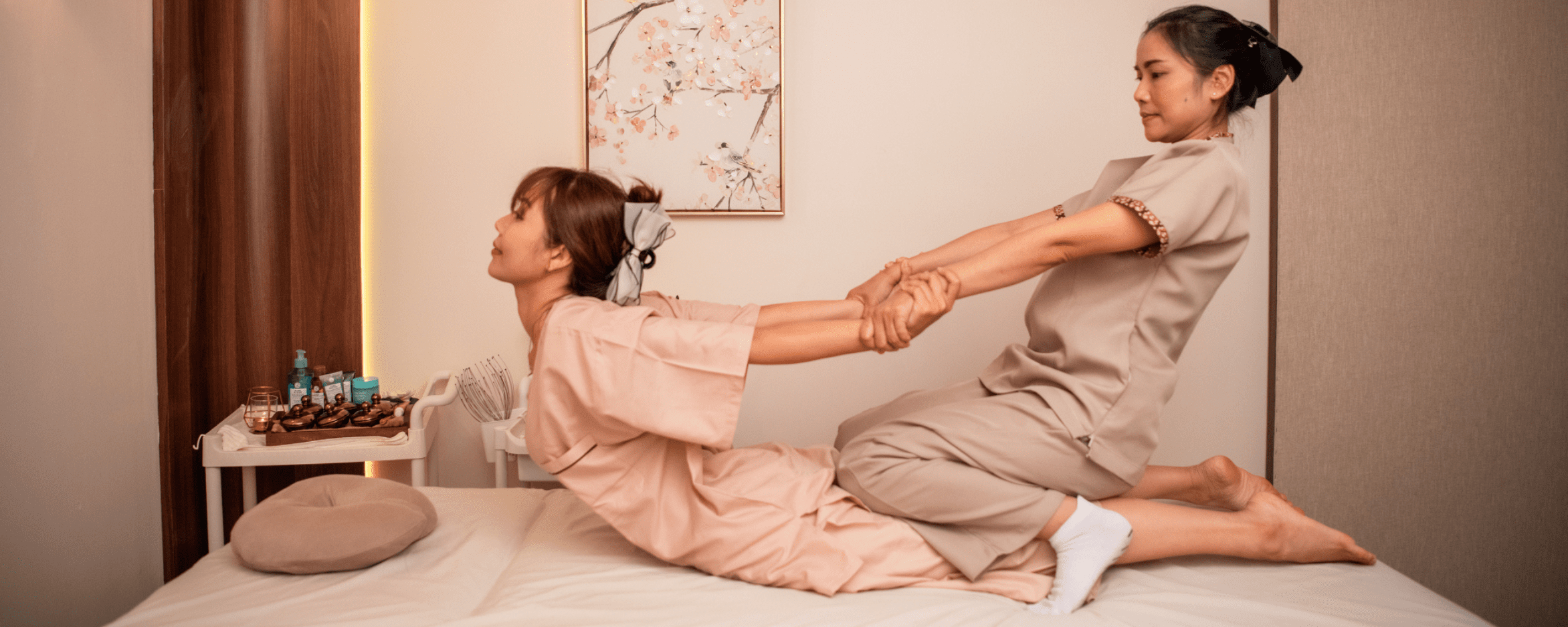
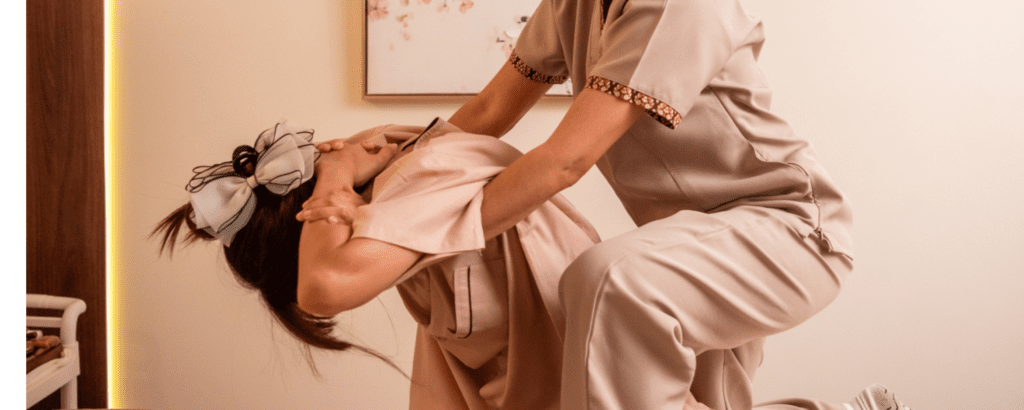
Thai massage is performed fully clothed – loose cotton provided – on a firm mat or bed. There is no oil. Instead, the therapist uses their hands, thumbs, elbows, knees, and sometimes feet to apply steady rhythmic pressure along the body’s sen lines, the network of energy pathways that traditional Thai medicine has worked with for centuries. Interspersed throughout are assisted stretches – your leg lifted into an arc you could not have managed alone, your spine gently decompressed, your hips opened in ways that feel quietly miraculous after a week at a desk.
The result is energising as much as it is relaxing. Guests consistently describe leaving a Thai massage session feeling taller – genuinely, physically more upright. The joints have more range. The muscle groups that had quietly seized around stress patterns have been unknotted from the outside in. It is not the blissful dissolution of the aroma oil table. It is something sharper and more structural: the feeling of a body that has been properly recalibrated.
Research published in the journal Complementary Therapies in Medicine found that Thai massage has a measurable effect on the autonomic nervous system – specifically, it activates the parasympathetic response (the rest-and-digest state) while simultaneously reducing the muscle tension markers associated with prolonged sympathetic activation. In plain language: it calms the nervous system while physically working out what the nervous system had made tight.
Thai massage tends to suit guests who are carrying physical stiffness in specific areas – the lower back from long-haul flights, the neck and shoulders from screen time, the hips from sitting across time zones. It also suits people who find it difficult to simply lie still for an hour. Because the therapist is moving you as much as pressing on you, there is something to follow, something to surrender to that feels active rather than passive. If you’ve been wondering whether Thai massage might feel too intense, the honest answer is: with a skilled therapist and clear communication about your pressure preference, it is more likely to feel like a relief than a challenge.
What Aroma Oil Massage Actually Does
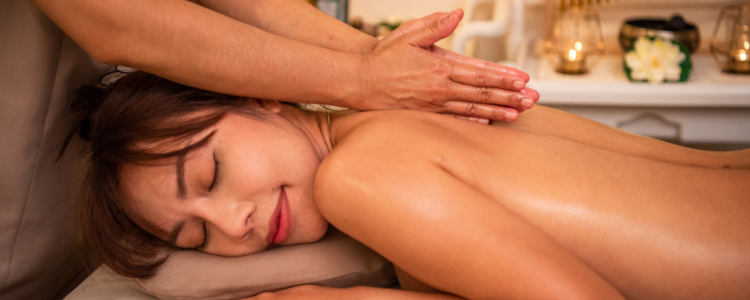
Aroma oil massage works through an entirely different mechanism. You are unclothed on a soft bed, fully draped at all times. The therapist uses long, slow, flowing strokes – effleurage and petrissage in the language of Swedish massage – applied with warm organic essential oils. There is no deep structural work. No stretching. No pressure that surprises. Instead, there is a continuous rhythm that the nervous system eventually stops resisting and simply follows down into something close to sleep.
The oils are not decorative. At Chandee’s aroma oil table, the blends are chosen for their effect on the nervous system – not just their scent, though the scent matters too. Lavender, bergamot, and similar botanical extracts have been shown in multiple studies to reduce cortisol levels and improve both sleep onset and sleep quality. A 2018 review in Evidence-Based Complementary and Alternative Medicine found that aromatherapy massage significantly reduced anxiety and improved sleep quality in participants across multiple clinical settings. This is not wellness marketing. The chemistry is real.
The primary effect of aroma oil massage is sedation – in the best possible sense. The body’s fight-or-flight circuitry quiets. The muscles release the low-level tension they hold as a default state in people under chronic stress. And because the strokes are long and unbroken and the room is calm, the mind follows the body into something like genuine stillness. Most guests fall asleep within twenty minutes. Many wake at the end of the session uncertain, for a moment, where they are. That moment of gentle reorientation – the room, the warmth, the faint scent of oil on the skin – is one of the most consistent things guests describe in reviews, and it is not an accident. It is the whole point.
Aroma oil massage is the better choice when stress is the primary concern rather than physical stiffness, when sleep has been poor, when anxiety has been high, or when you simply need to completely switch off from a mind that will not stop. It is also the more intuitive choice for guests who have never had a professional massage before – the pressure is consistent and non-surprising, the draping provides complete privacy, and the session never asks anything of you beyond the permission to rest.
The Warm Aroma Oil and Hot Stone Options
Worth mentioning here, because guests sometimes overlook them: Chandee also offers a Warm Aroma Oil Massage and a Hot Stone Massage, both of which are variations on the aroma oil experience rather than separate categories.
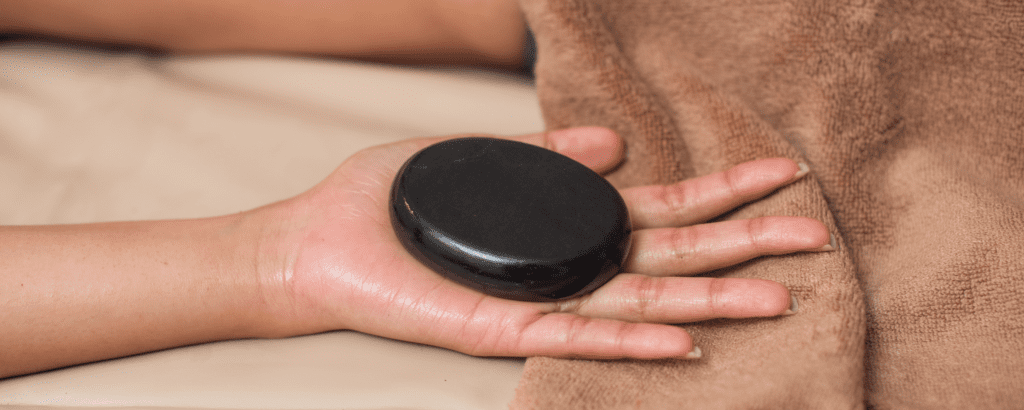
The Warm Aroma Oil session uses heated oil applied at a temperature that adds another layer of muscle release – particularly effective in Bangkok’s air-conditioned environments, where the contrast between chilled indoor air and the body’s natural warmth can leave muscles in a mild state of contraction. The hot stones used in the Hot Stone Massage serve a similar purpose: smooth basalt stones, warmed and placed along the body’s key tension points, allow the heat to penetrate more deeply than hand pressure alone. Both are available at 90 and 120 minutes. If you run cold, carry tension in your lower back, or simply want the most deeply physical form of warmth the table can offer, these are worth considering over the standard aroma oil option.
All aroma oil sessions at Chandee use authentic local oils – not the Yves Rocher organic products, which are reserved exclusively for the head spa ritual. The local oil blends are selected for their quality and their effect rather than brand recognition, and they change with the season and the therapist’s read of what the guest needs.
Can You Combine Them?
Yes – and many guests do. The most popular combination at Chandee pairs the head spa ritual with either Thai or aroma oil massage, with the head spa typically completing the session. The logic is intuitive: the body massage releases the physical tension in the muscles, and the head spa then addresses what remains in the scalp and the nervous system. The transition from one to the other – from the firm structural work of Thai or the slow warmth of the oil table to the water sounds and gentle scalp pressure of the 17-step Ring of Water ritual – is consistently described by guests as one of the most complete sensory transitions they have experienced in any spa setting.
The Head Spa and Aroma Oil Massage combination runs 90 minutes at 2,200 THB or 120 minutes at 2,800 THB. The Head Spa and Thai Massage combination runs 90 minutes at 1,900 THB or 120 minutes at 2,300 THB. For guests who want to go further, the Chandee Master Course at 180 minutes (4,200 THB) adds a full facial into the sequence – Gua Sha, V-shape contouring, and eye care – before the head spa closes the experience under the hand-painted starry ceiling.
If you are uncertain which body massage to pair with the head spa, the simplest guide is this: choose Thai if you have been sitting or travelling heavily, choose aroma oil if you have been stressed or sleeping poorly. Both lead to the same destination. They just take a different road to get there.
A Note on Stress, Tension, and the Body’s Memory
One thing that rarely gets said clearly in spa guides is that the body keeps score. Chronic stress does not just make you feel anxious – it physically contracts muscle tissue, compresses joints, and disrupts the sleep architecture that allows proper overnight recovery. Stress also has measurable effects on the scalp, which is part of why combining a body massage with the head spa produces results that feel qualitatively different from either session alone.
Bangkok amplifies this. The heat, the noise, the pollution, the pace of the city – and for international visitors, the accumulated physiological toll of long-haul flights, changed time zones, and the low-grade vigilance that comes with navigating a new environment – all of it lands in the body and stays there until something moves it. Both Thai massage and aroma oil massage do that moving. They just work on different layers of the same problem.
Making the Choice
If you are still weighing options, here is the simplest version of the decision.
Choose Thai massage if you have been sitting for long periods, your joints feel compressed or stiff, you want to feel energised and mobile rather than sedated, or you find it hard to simply lie still and would prefer to be guided through movement. The session at Chandee runs from 730 THB for 30 minutes to 1,250 THB for 120 minutes. You can browse the full breakdown on the massages page.
Choose aroma oil massage if your primary concern is stress, anxiety, or poor sleep, you want warmth and sensory immersion rather than structural work, or you are new to massage and want an experience that feels consistently gentle and calming. Aroma oil massage at Chandee starts at 1,300 THB for 60 minutes and runs to 2,100 THB for 120 minutes. The warm and hot stone variations are available at 90 and 120 minutes respectively.
And if you are still not sure when you arrive at the salon – at Silom or at our second location opening on Sukhumvit 39 in April 2026 – just ask. Our team will spend two minutes with you, ask the right questions, and point you in the right direction. That moment of genuine, unhurried advice is something guests mention more often than almost anything else in their reviews. It is not a service script. It is just how we work.
Reserve your session online, or walk in any day between 10 AM and 11 PM at our Silom location on Naradhiwas Rajanagarindra Road, a short walk from BTS Chong Nonsi and King Power Mahanakhon Tower and at Sukhumvit 39 . We are open when most of Bangkok has already closed.