Most places hire therapists. We build them.
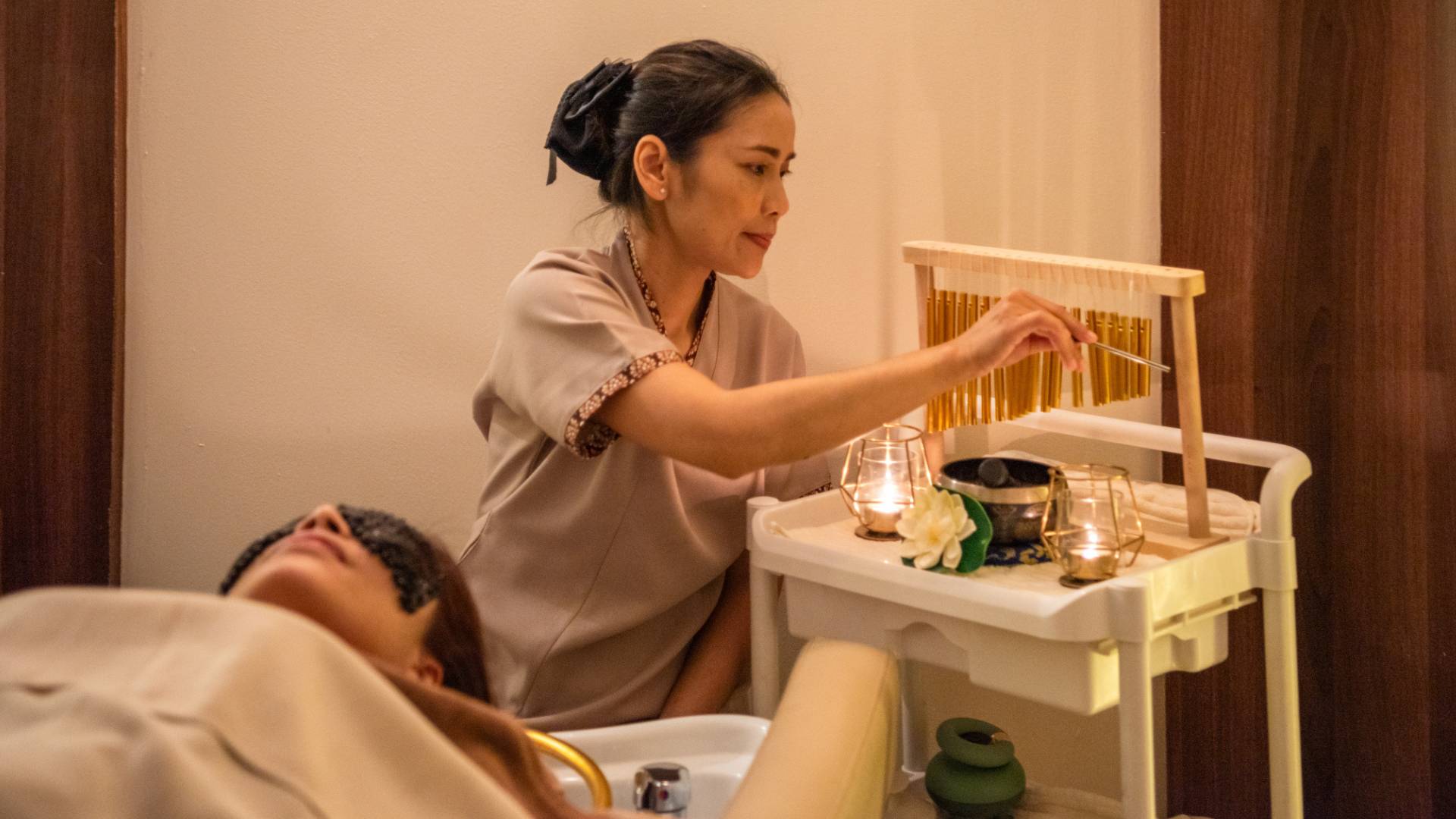
There is a moment that happens at Chandee that guests describe in their reviews more than almost anything else. It is not a specific technique, though the techniques are precise. It is not the starry ceiling, though the ceiling is unforgettable. It is something harder to name: a quality of presence, of attention, of care that settles over you the moment a therapist’s hands begin to move.
People write things like: “I felt completely safe.” Or: “She somehow knew exactly what I needed.” Or simply: “I fell asleep before the second step.”
That quality does not happen by accident. It is trained.
At Chandee, we have made a deliberate choice that sets us apart from nearly every other spa in Bangkok: we train our own therapists, in-house, from the beginning. Not just orientation. Not just a brief product demo. A full, structured programme built around the specific rhythms, pressures, and intentions that define the Chandee experience, including the 17-step Ring of Water ritual that sits at the heart of everything we do.
This article is about why that decision matters, what the training actually involves, and what it means for you the moment you lie back and close your eyes.
Why Most Spas Don’t Train and Why That’s a Problem
Bangkok has thousands of massage shops. Many are excellent. But the industry as a whole runs on a model of hiring certified practitioners and deploying them quickly, the assumption being that a Thai massage certificate or a cosmetology diploma is sufficient preparation for the job.
For a standard massage, it often is. But head spa work is a different craft entirely.
The Vietnamese head spa tradition, which forms the core of what we do at Chandee, is not taught in most Thai massage schools. It is a specific lineage of technique that evolved in Vietnamese hair salons, became a viral phenomenon in Vietnamese social media (the “Goi Dau” head wash videos have collectively been watched billions of times), and eventually travelled to cities like Bangkok, Seoul, and Tokyo, where dedicated head spa studios began to build on the tradition.
When we opened Chandee as Bangkok’s original Vietnamese Sleep Salon, we could not simply hire therapists who already knew the method. Almost no one in Bangkok did. We had to build the knowledge ourselves and then transmit it, carefully, to every person who joins our team.
This is not a complaint. It is one of the things we are most proud of.
What “In-House Training” Actually Means at Chandee
When a new therapist joins the Chandee team, they do not start with guests. They start on each other.
The first weeks are about foundations: pressure calibration, hand positioning, the specific water temperature and flow patterns that create the ASMR sensation that so many guests describe as “like rain on a rooftop.” They learn to read a guest’s breathing, how it shifts as tension releases, how it deepens when the right spot is found.
Then comes the Ring of Water ritual itself.
The 17 Steps and Why Every One Is Non-Negotiable
Chandee’s signature head spa ritual has 17 distinct steps. We ask our therapists to memorise not just the sequence but the intention behind each one because there is a logic to the order that guests cannot see but absolutely feel.
The ritual moves in an arc:
- Opening: Grounding the guest. Slowing the nervous system down. The first contact is always unhurried, deliberate, and warm.
- Middle: The deep work. Scalp massage, water flow, the gradual layering of pressure and release that most guests describe as the moment they “let go.”
- Organic product application: Yves Rocher shampoo and conditioning products, applied in sequences timed to the ritual’s rhythm, not rushed.
- ASMR elements: Water sounds, light tapping, the specific audio textures that cue the brain into near-sleep states.
- Closing: A gentle, warm hair dry and neck sequence that signals completion without abruptness. Guests are brought back slowly, not jolted out.
A therapist who misses a step or rushes a transition disrupts the arc. The guest may not consciously know why the experience felt slightly “off” but they feel it. This is why our standard is not flexible on sequence. The 17 steps exist in that order for a reason.
The Thing That Can’t Be Taught From a Manual
The sequence can be written down. Pressure guidelines can be standardised. Product knowledge can be tested.
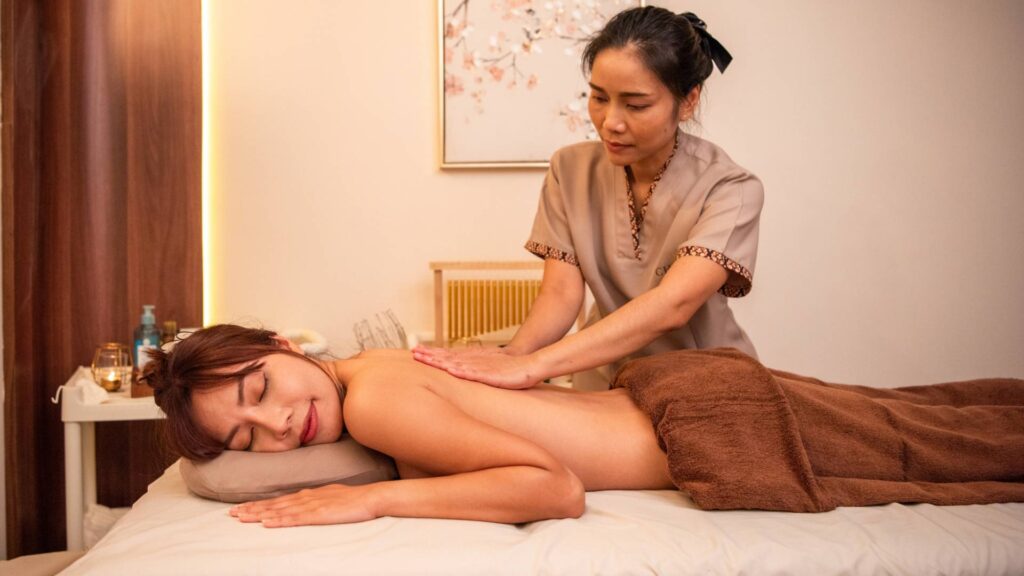
But the quality that guests most often describe – that feeling of genuine care, of being truly seen is not in any manual. It is transmitted person to person, and it starts with the culture of the team itself.
Chandee is a family-run business. That is not a marketing phrase. It means that the people who founded this place are present in it, watching, correcting, celebrating, caring about the experience in a way that filters down through every team interaction. When our senior therapists teach new joiners, they are not just passing on techniques. They are passing on an attitude: that the guest in front of you right now deserves your complete attention.
International guests who make up around 80% of our visitors, arriving from the US, Singapore, Australia, India, Germany, and beyond, are often struck by how this feels compared to chain spas they have visited elsewhere. The boutique difference is real, and it lives in the people.
A Day in the Life: What New Therapist Training Looks Like
We thought it might be useful to walk through what a typical training day looks like at Chandee. This is not a formal curriculum document – it is more of a window into the rhythm of the place.
Morning: Observation and Repetition
New therapists begin by watching. Senior therapists demonstrate the full head spa ritual from start to finish, narrating choices as they work. The new therapist’s job is simply to absorb the pace, the hand positions, and the way a senior therapist adjusts pressure after reading a guest’s micro-reactions.
After observation comes repetition among fellow team members. This serves two purposes: the trainee gets hands-on practice, and the “guest” (actually a colleague) is encouraged to give real, honest feedback about what they feel. This peer feedback loop is one of the most valuable tools in the programme.
Afternoon: Specialisation
Chandee offers more than just the head spa. Training also covers the Thai massage sequences, the aroma oil work, and the facial treatments that form our fuller packages. Therapists who eventually become specialists in one area still need foundational competence across the menu because a guest booking the Chandee Master Course (180 minutes of full-body massage, facial, and head spa combined) deserves smooth, continuous care across every phase.
Ongoing: Calibration and Feedback
Training does not end after onboarding. Every few weeks, therapists do calibration sessions with each other, checking that pressure standards have not drifted, that ASMR techniques remain consistent, that the rhythm of the 17 steps hasn’t been silently accelerated by habit or busyness.
Guest reviews are also part of the feedback loop. When a review mentions a specific therapist or a specific moment in the ritual by name, that note makes its way back to the team. Positive and negative alike.
What This Means for Guests With Specific Needs
Because our therapists are trained in-house across a range of techniques, they are better equipped to adapt when guests have specific physical situations to communicate.
Some common ones:
- Hair extensions: Our therapists are trained to adjust water pressure and product application for guests with extensions, which is why we have a clear and fair hair extensions policy – and why the experience still works beautifully. We recommend 90 minutes or more for guests with longer extensions.
- Neck and shoulder tension: This comes up constantly for office workers and long-haul travellers. Our therapists recognise the patterns and adjust accordingly. The Office Syndrome massage is specifically built around this, but even in a standard head spa session, a good therapist notices and responds.
- Sensitive scalps: Product sensitivity, post-colouring scalp irritation, and general tenderness are all things therapists learn to identify and work around without disrupting the ritual.
- First-time guests who are nervous: This is actually the most common “specific need” of all. If you have never had a head spa before and you are not sure what to expect, our first-timer’s guide covers the practical preparation. But in the room, the therapist’s job is to help you feel safe enough to surrender to the experience. That takes training, too.
Why This Matters for Bangkok’s Head Spa Scene
Bangkok’s spa industry is one of the most competitive in Asia. The city has everything from five-star hotel spas with international accreditation to tiny storefronts charging 200 baht for an hour. The middle ground – boutique specialists with genuine technique and a defined identity – is a harder space to occupy, but it is where the real craft lives.
Chandee’s decision to train our own therapists is part of a broader belief: that if you are going to own a category – and we do, as Bangkok’s original Vietnamese Head Spa and Sleep Salon – you have to own the quality that defines it, from the inside out.
Competitor head spas in Bangkok tend to focus on either the scalp-science angle (microscope analysis, carbonated rinses, clinical language) or the luxury-product angle (premium imported shampoos, high-end finishing). These are valid positions. But Chandee’s position is different: the experience is the product. The skill of the therapist, the warmth of the room, the hand-painted starry ceiling above you, the water sounds, the 17 steps arriving in exactly the right order at exactly the right pace – these are what people come for. And these cannot be outsourced or bottled. They have to be built, person by person, over time.
A Note on What “Boutique” Really Means
The word “boutique” gets used loosely in wellness marketing. It can mean “small,” or “expensive,” or simply “not a chain.”
At Chandee, boutique means something specific: we can see every guest, every session. We know when a new team member needs more time on a particular sequence. We know which guests are regulars, which are first-timers, and which are celebrating something. We have guests who visit three or four times during a single Bangkok trip, not because they need four head spas, but because the experience is reliable enough, and warm enough, that coming back feels like returning somewhere familiar.
That reliability is a product of training. And the warmth is a product of the kind of team culture that only comes from building people, not just hiring them.
When you book at Chandee, whether at our original Silom branch near King Power Mahanakhon Tower, or at our new Sukhumvit 39 branch near BTS Phrom Phong, the therapist whose hands you trust has been through this process. They know the 17 steps. They know the water arc. They know how to read the shift in your breathing when you cross the threshold from “relaxing” into something deeper.
They were taught to care. And, in our experience, people who were taught to care are the ones who actually do.
Come and Feel the Difference
Articles like this one can describe what happens inside our training programme. They cannot replicate what you feel when a well-trained Chandee therapist begins the Ring of Water ritual, the weight of the day lifting, step by step, until all that’s left is the sound of water, the soft light of a starry ceiling, and the very welcome sensation of having nothing to do but rest.
That is what we train toward. Every time.
Chandee’s approach to the 17-step ritual is part of what guests consistently describe when they call us the best head spa in Bangkok – and it’s a distinction that shows up the moment a therapist’s hands begin to move.
Chandee Sleep Salon and Massage is open daily, 10 AM to 11 PM, in Silom and Sukhumvit 39. Book your session here – or if you are new to Head Spa and wondering where to start, read our first-timer’s guide first.